
The Making of the Laughing Man
The Man Who LaughsGwynplaine’s imposed face becomes both the source of his livelihood and the mark that defines his social isolation.
increasing Bearing strength in each event
 decreasing
Bearing strength in each eventdecreasingA Face Manufactured
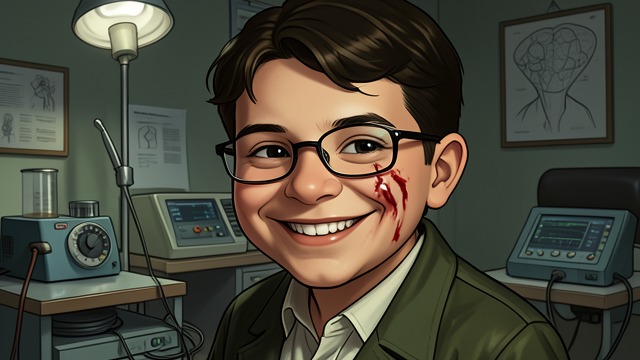
A Face Manufactured
The operation
Hardquanonne reshapes the child’s face into an everlasting grin.
The procedure turns bodily harm into a planned commercial skill.
Gwynplaine has no memory of the operation.
A living stigma
The face fixes laughter onto every later emotion.
His inner life remains hidden behind an imposed expression.
His appearance records power’s violence without explaining it.
A Mountebank’s Survival
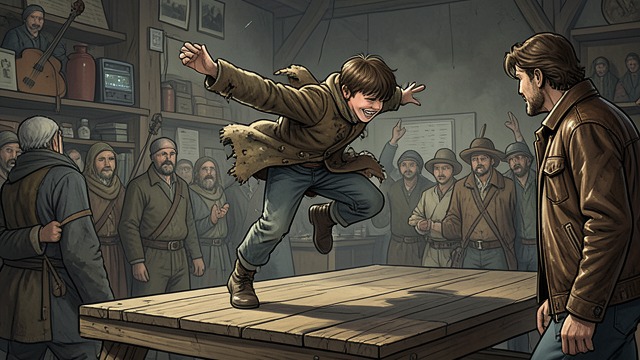
A Mountebank’s Survival
Skills for the road
Ursus teaches Gwynplaine performance, language, and practical arts.
The boy’s physical agility suits the life of a travelling show.
Education gives him resources while leaving the original injury intact.
Poverty made workable
The troupe earns coins by exhibiting his face.
Gwynplaine accepts the work as a means to support Dea.
A wound becomes livelihood, but never ceases to be a wound.
The Crowd Laughs
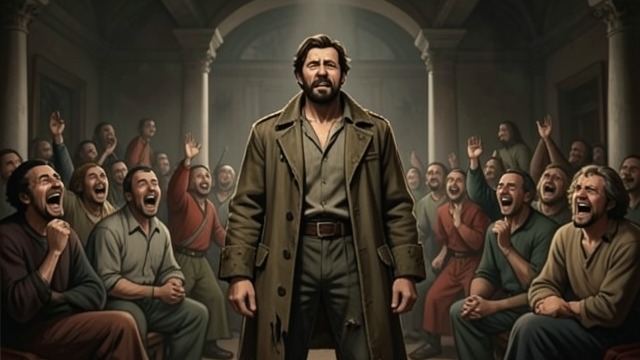
The Crowd Laughs
A theatrical revelation
Ursus’s drama hides Gwynplaine until the final light exposes him.
The crowd erupts in laughter at the sudden sight of his face.
A serious performance becomes an unintended comic triumph.
Success with a cost
The laughter brings money and public attention.
Gwynplaine gains independence for the small troupe.
The same audience that pays him refuses to see his suffering.
The House Laughs Back
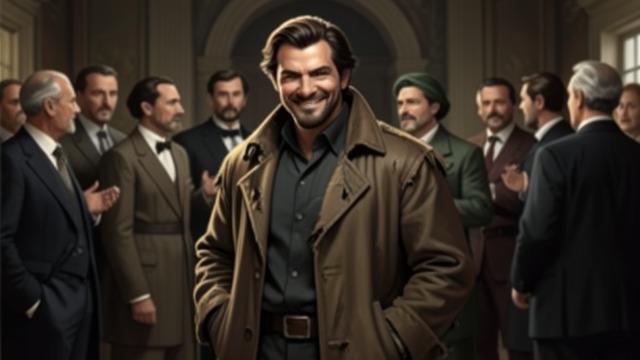
The House Laughs Back
A deliberate testimony
Gwynplaine tries to describe poverty to the privileged peers.
He speaks from lived hardship and asks them to recognize the poor.
For a moment he suppresses his habitual grin.
The face defeats the speech
Emotion restores the involuntary laugh to his features.
The peers turn his testimony into a spectacle.
His public mask silences the person trying to speak through it.
The Mask Understood
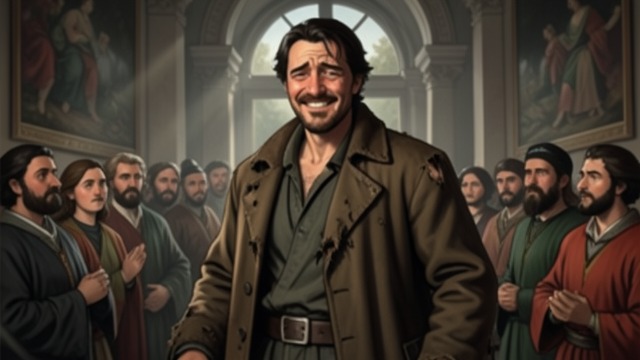
The Mask Understood
The meaning of the grin
Gwynplaine sees his face as an image of imposed public cheer.
His laughter has concealed anger, sorrow, and an accusation against power.
The mask turns private injury into a wider social symbol.
No escape from the sign
The audience’s ridicule confirms the separation between his face and his mind.
Gwynplaine cannot remove the expression that others read first.
The lasting stigma outlives both his performance and his title.
Around 1682, when Gwynplaine is two
During Gwynplaine’s boyhood with Ursus
During the first performances of Chaos Vanquished
During Gwynplaine’s first speech in the House of Lords
Late that night, after the House of Lords adjourns
